Chloe Macdonald is currently studying Social Science Research Methods (MSc) as part of her 1 + 3 PhD programme at Cardiff University, previously she has completed an MSc in Forensic and Investigative Psychology. MacdonaldCL1@cardiff.ac.uk
My research
For my MSc research, I wanted to focus on how appropriate adults (AAs) and police officers construct vulnerability and how this may impact their choices when responding to vulnerability. These aims formed my central research question; ‘How do police officers and AA’s perceptions of vulnerability affect the interventions they make in custody on behalf of vulnerable suspects’. Findings illustrate that AAs and police officers perceive vulnerability in contrasting ways, which impacts how they recognise and respond to vulnerability when encountering vulnerable suspects at custody.
Methods
A mixed methods approach was utilised for this study, combining quantitative and qualitative components, across two phases of research design, which are outlined below.
Phase One – Part 1 – Bias questionnaire
Firstly, a survey was sent via professional contacts and social media to recruit police officers (that have been previously or currently based in custody) and AAs (who were trained AAs from schemes). The first part of the survey was a newly constructed bias questionnaire. Elements were taken from existing surveys on biases when supporting vulnerable offenders including, mentally ill, violent, and juvenile groups. These categories were chosen as they represent demographics often seen in custody (Farrugia, 2021). The reason for this inclusion was to see if there was any correlation between biases against offenders and how AAs/police officers respond to suspects throughout the custodial process.
Phase One – Part 2 – Vignettes
For the second part of the survey, participants were allocated to one out of four groups. The four groups were as follows:
- Juvenile | Overtly Vulnerable
- Juvenile | Covertly Vulnerable
- Adult | Overtly Vulnerable
- Adult | Covertly Vulnerable
The four groups displayed a vignette to participants, which I wrote based on my previous professional experiences within the custody suite. Specifically, vignettes are a method of research design which create realistic case studies, to study participants responses, which allow for their actions to be analysed, without entering a real-life situation (Aguinis and Bradley, 2014). Vignettes have recently been used in police literature to explore decision making in custody (Farrugia, 2021).
The vignettes were constructed with the purpose in mind that detainees present their vulnerability in different ways, sometimes through physical and/or mental states it can be easier to spot when someone is vulnerable (overt group), and other times detainees may appear as more quiet or withdrawn, and possibly get mistaken for understanding the situation, but this is not to say they are any less vulnerable (covert group), (Bath and Dehaghani, 2020). It is important to highlight that vulnerability is fluid and dynamic, and factors such as mental, emotional, psychological, and environmental changes can increase or decrease someone’s vulnerability (Dehaghani, 2019). Practically, this means that those encountering vulnerable detainees must be able to recognise and respond to vulnerability.
Participants were walked through six custodial processes, which broadly speaking span the starting point of an AA meeting a detainee, to when the detainee receives an outcome at the end of their time in custody. The six stages were the same for police officers, with wording slightly changed to reflect their role is different to the AAs.
The six stages were:
- Meeting the detainee / Private Chat
- Getting a solicitor
- Understanding the caution
- Participating in the interview
- Receiving the outcome
- Going home
The stages were chosen to reflect that the AA and police involvement with vulnerable detainees spans several processes, and that vulnerability can be present throughout any point in custody, not just the police interview which is more focused upon in academia than other custodial processes (Bath and Dehaghani, 2020).
Participants were asked to choose how they would respond to the detainee in each stage of the custodial process, options ranging from no intervention to some form of intervention e.g. asking the detainee if they understood, to a higher level of intervention e.g. stopping the process, or the AA and police officer working together to re explain something to the detainee. There was also the option of using a free text box where participants could explain what intervention, if any, they would take.
Phase two – Interviews
The second phase of the study was to interview police officers and AAs to learn more about how they perceive vulnerability, and how this influences how they interact with vulnerable detainees at custody. Ten participants, five from each group, were interviewed. Semi structured interviews were conducted via telephone, and the interviews were designed to explore the perception of vulnerability, engaging with vulnerable detainees, and any barriers to responding to vulnerability.
My findings
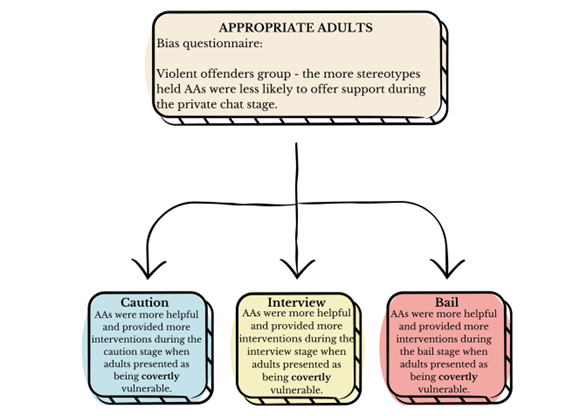
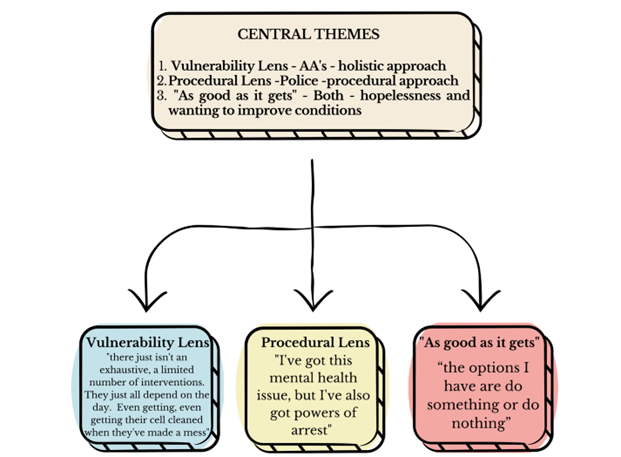
The quantitative and qualitative phases of the study both complement each other in terms of the findings. An overview of the findings is presented through illustrative diagram. In the qualitative analysis, three central themes were constructed through reflexive thematic analysis. In both stages of the analysis, AAs and officers responded to and constructed vulnerability in different ways, which may aid our understanding of how vulnerability is constructed within the custody suite and the impact this has on vulnerable detainees.
Quantitative Findings:

Qualitative Findings:
Impact of Findings:
There were several important findings which emerged from the current study. Firstly, it highlighted that biases play a part in how AAs and police officers respond to vulnerability, which may impact their decision making when encountering vulnerable suspects. Secondly, the study highlighted that AAs and police officers respond to vulnerability in different ways, with AAs detecting more nuanced vulnerability and officers responding to more obvious vulnerability. When paired with the qualitative findings that AAs report positive experiences in relation to their training, and police officers report negative (or non-existent) experiences, a picture emerges of how the two groups perceive and intervene with vulnerability at the custody suite. Thirdly, emerging from the qualitative phase, both groups reported experiencing barriers to making interventions when vulnerability had been recognised, for AAs, this was mainly experiencing the police as a barrier, either through the police not having time/resources to respond to their concerns, or through a lack of understanding/caring when the AA shared concerns around vulnerability. For police, they reported a lack of confidence in responding to vulnerability, through a combination of lack of training and lack of support/resources from their superiors. Finally, the findings also highlight that both AAs and police officers feel that the current custody environment is failing vulnerable suspects, through a combination of factors such as physical environment, lack of health and welfare resources, and sheer volume of suspects.
Of course, any study utilising vignettes must acknowledge this may not necessarily reflect decisions made in real life, however they are a starting point at the very least for navigating socio-legal situations (Youngs and Billings, 2020). Combining the survey with qualitative interviews has allowed for a more in-depth exploration into vulnerability in the custody suite.
Future research and practice
The findings have both academic and practical implications. Firstly, more research is needed to explore interventions taken by AAs at the custody suite, and any barriers to them making interventions, with the voice of the AA often missing in academia, despite it being a procedural safeguard for vulnerable suspects (Jessiman and Cameron, 2017). Secondly, future research should focus on current policing culture, and how the role of the police has shifted from investigating crime to social welfare (Leese and Russell, 2017). More specifically, the impact this has on vulnerable suspects who encounter the police, and the effect this has on the police themselves should be explored, with police participants from this study reporting feelings of burnout and a loss of identity. Thirdly, from a practice standpoint, AA schemes and their respective local police force should seek to develop or continue an effective working relationship, for example, local police forces may feel the benefit of having some form of joint training with AA schemes, on AA practice and vulnerable suspects, and AA schemes would benefit from having a local platform in which to raise and manage concerns about vulnerability in the custody suite.
Conclusion
This study aimed to investigate how vulnerability was constructed by AAs and officers, and if this could impact their actions when encountering vulnerability, through the research design, I feel as though the study achieved its aims, and hopefully can contribute to the existing and growing literature on police custody and the appropriate adult safeguard.
References
Aguinis, H. a Bradley, K. J. 2014. Best practice recommendations for designing and implementing experimental vignette methodology studies. Organizational research methods 17(4), tt. 351-371.
Bath, C. a Dehaghani, R. 2020. There to Help 3: the identification of vulnerable adult suspects and application of the appropriate adult safeguard in police investigations in 2018/19.
Dehaghani, R. 2019. Vulnerability in police custody: police decision-making and the appropriate adult safeguard. Routledge.
Farrugia, L. 2021. Identifying vulnerability in police custody: Making sense of information provided to custody officers. Journal of forensic and legal medicine 80, t. 102169.
Jessiman, T. a Cameron, A. 2017. The role of the appropriate adult in supporting vulnerable adults in custody: Comparing the perspectives of service users and service providers. British Journal of Learning Disabilities 45(4), tt. 246-252.
Leese, M. a Russell, S. 2017. Mental health, vulnerability and risk in police custody. The journal of adult protection.
Young, K. M. a Billings, K. R. 2020. Legal consciousness and cultural capital. Law & Society Review 54(1), tt. 33-65.

