Kim Turner, Speech and Language Therapist and Senior Lecturer, Department of Health Professions, Manchester Metropolitan University.
Claire Westwood, Speech and Language Therapist and Lecturer, School of Health and Care Professions, Birmingham City University.
Introduction
Imagine sitting through an entire trial where you don’t understand any of the charges or evidence against you. Questions are repeatedly asked that you can’t make sense of and so you give any answer you can. It culminates in a judge sending you down to the cells where you find out that you’re being sent to prison. For some people this isn’t a fictitious scenario, but a real-life event.
It is increasingly recognised that a significant proportion of defendants have speech, language and communication needs (SLCN) (Anderson, Hawes, & Snow, 2016; Sample, Montague Jr, & Buffalo, 1989). This can involve struggling to understand what is said, formulating responses and negotiating social interactions.
The criminal justice system is heavily verbally mediated, placing huge linguistic demands on individuals who are likely to have needs in this area and be further adversely impacted by the stress of the situation (Sirianni, 2004). This can then impact on the defendant’s right to a fair trial under Article 6 of the European Convention of Human Rights as they are not able to be informed of the nature and cause of the accusation against them, and prepare and effectuate their defence (Johnston et al., 2016).
Why does this matter? Having a young adult arrive at prison reception having believed they had been acquitted and were being given a lift home cannot be right, just or fair.
What are speech, language and communication needs?
Individuals can be born with SLCN (developmental) or may develop them as a result of illness or injury (acquired). These can be associated with another condition (e.g. learning disability or stroke) or can exist on their own. It is estimated that SLCN that significantly impacts an individual’s daily functioning affects 3-10% of the general population (Enderby & Pickstone, 2004) however this grows to over half of those in contact with the criminal justice system.
SLCN is both under-identified and a hidden disability (Bishop, 2017). Research has demonstrated that individuals with SLCN are unlikely to have had these diagnosed prior to contact with the Criminal Justice System (CJS, Hughes et al., 2017). For some, this may have meant negative school experiences and school exclusion due to not understanding the work expected of them. For others, it may have manifested in internalised anxiety and disengagement.
Communication breakdown linked to SLCN could make an individual vulnerable in the CJS. Often both the speaker and listener are unaware of the presence of a difficulty, making communication breakdown highly likely. Below are some examples of how communication could breakdown in the CJS (Turner & Westwood, 2023):
| Presentation | Potential SLCN | Behind the SLCN | Potential Impact |
| Inconsistent story | Narrative language and/or sequencing difficulties | In trying to arrange the language elements correctly, they create ‘different’ stories with different meaning. | May be judged to be unreliable or lying as seen to be trying to fill gaps in their story. |
| Words ‘parroted back’ or used out of context | Restricted vocabulary | In trying to speak ‘properly’ and adapt to their surrounding, words get used out of context or without understanding. | Deemed to understand conditions when they do not. |
| Unrelated/unexpected reply | Receptive language impairment | Individual may have only understood part of the question or may be guessing the answer. ‘Yes’ is generally deemed to be the ‘correct’ response when asked a question. | The accused may incorrectly implicate themselves through lack of understanding: A: ‘So, you feel culpable of the offence?’ B: ‘Err, yes?’ |
| Facial expressions incongruent | Receptive language impairment and/or Pragmatic language impairment | Individual may not have understood the interaction correctly or may not know how to respond in this unfamiliar situation. | Smiling when faced with a victim could be viewed negatively by the jury, whilst the individual has been taught to ‘be friendly’ to everyone at court. |
How can SLCN be supported?
The above information shows the significant negative impact unsupported SLCN can have for an individual in the CJS. It is therefore important that professionals know of and implement strategies and processes available to them to ensure fair access to justice.
The SOLD network user group contributed their invaluable experiences via a focus group. The SOLD user group is a group of people who all have a learning disability and experience of the criminal justice system. Their network has developed a range of resources to support effective participation in legal proceedings https://soldnetwork.org.uk/ We asked them what would’ve helped them to participate more effectively at court. They suggested:
- Show empathy – try to understand what it’s like for us
- Take the time to understand us properly
- Always give us a choice
- Get trained in how to understand people with learning disabilities
- Be passionate about your work – don’t just treat it like any other job
- Be confident about challenging other people/services when they treat us unfairly
- Never assume you know what’s in our best interest without asking us
- Adapt your language – use simple words, and be patient
There is also free training and resources available for professionals working in the CJS to learn more:
- The Box e-learning – https://www.rcslt.org/learning/the-box-training/
- The Advocates Gateway toolkits – https://www.theadvocatesgateway.org/toolkits-1-1-1
- Communication Access (CAUK) training – https://communication-access.co.uk/
- The Access Brief guidance – https://www.communicourt.co.uk/welcome-to-the-access-brief/
Vulnerable people with SLCN are also able to access intermediaries to support them through the CJS processes. These are communication specialists who can facilitate access by, for example, simplifying questions and facilitating expansion on responses. Comprehensive information on this can be found in Plotnikoff and Woolfson (2015), Backen (2017) and the link to The Access Brief above.
What next?
We believe there should be systematic screening of SLCN on initial contact with the CJS to identify individuals who would benefit from support to ensure a fair trial. There are examples of good practice but this is not consistent or cohesive across regions. Five key opportunities to implement screening for young people up to 18 years can be seen below (Westwood, 2021):
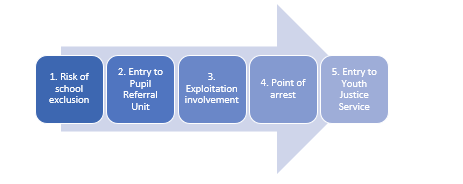
For adults, an example of good practice is to have SLCN screening within Liaison and Diversion services (L&D) at police custody to identify vulnerable people as early in the process as possible and provide support/recommendations or to divert them to more appropriate(Holland, Hutchinson, & Peacock, 2023).
Ensuring communication needs are identified and supported at the earliest available opportunity allows the vulnerable accused to understand and engage in the process more effectively, averting significant negative impacts for all. Significant advances have been made in the last 20 years, including the introduction of systematic screening for all under 18’s in contact with the criminal justice system in England & Wales (Youth Justice Board, 2014) and the extension of the intermediary schemes across the world (Kearns et al., 2023). However, a systematic and effective process for identification of needs and standardised support measures at all levels of proceedings is still required.
Post-identification, wider access to intermediaries and reasonable communication adjustments are still needed. Screening is simply the starting point to ensure communication in the courtroom is accessible to all…but would be a very significant next step.
Reference list
Anderson, S. A. S., Hawes, D. J., & Snow, P. C. (2016). Language impairments among youth offenders: A systematic review. Children and Youth Services Review, 65, 195-203. doi:http://dx.doi.org/10.1016/j.childyouth.2016.04.004
Backen, P. (2017). They just don’t get it: Communication and the work of an intermediary with vulnerable people in the justice system’: Independent.
Bishop, D. V. M. (2017). Why is it so hard to reach agreement on terminology? The case of developmental language disorder (DLD): Terminology and the case of DLD. International Journal of Language & Communication Disorders. doi:10.1111/1460-6984.12335
Enderby, P., & Pickstone, C. (2004). How many people have communication disorders and why does it matter? International Journal of Speech-Language Pathology, 7(1), 8-13. doi:10.1080/14417040500055086
Holland, C., Hutchinson, P., & Peacock, D. (2023). The importance of screening for speech, language and communication needs (SLCN) in police custody. The Howard Journal of Crime and Justice, n/a(n/a). doi:https://doi.org/10.1111/hojo.12514
Hughes, N., Chitsabesan, P., Bryan, K., Borschmann, R., Swain, N., Lennox, C., & Shaw, J. (2017). Language impairment and comorbid vulnerabilities among young people in custody. Journal of Child Psychology and Psychiatry, 58(10), 1106-1113. doi:10.1111/jcpp.12791
Johnston, K., Prentice, K., Whitehead, H., Taylor, L., Watts, R., & Tranah, T. (2016). Assessing effective participation in vulnerable juvenile defendants. The Journal of Forensic Psychiatry & Psychology, 27(6), 802-814. doi:10.1080/14789949.2016.1208264
Kearns, Á., Clarke, D., Cusack, A., Gallagher, A., Humphreys, J., Kedge, S., & McKee, A. (2023). Intermediaries in the justice system for people with communication disability: Enacting Sustainable Development Goal 16 in Ireland, Northern Ireland, and New Zealand. International Journal of Speech-Language Pathology, 25(1), 141-146.
Plotnikoff, J., & Woolfson, P. (2015). ‘Intermediaries in the criminal justice system: Improving communication for vulnerable witnesses and defendants’. Retrieved from London:
Sample, M. H., Montague Jr, J. C., & Buffalo, M. D. (1989). Variables related to communicative disorders in an adult prison sample. Journal of Criminal Justice, 17(6), 457-470. doi:http://dx.doi.org/10.1016/0047-2352(89)90077-9
Sirianni, J. P. (2004). Psychological stress and language processing in school-aged children. JOURNAL OF SPEECH LANGUAGE PATHOLOGY AND AUDIOLOGY, 28, 112-121.
Turner, K., & Westwood, C. (2023). Speech, Language and Communication Needs and the Role of the Speech and Language Therapist. In R. Dehaghani, S. Fairclough, & L. Mergaerts (Eds.), Vulnerability, the Accused, and the Criminal Justice System: Multi-jurisdictional Perspectives (pp. 147-161). London: Routledge.
Westwood, C. (2021). Blocking the School-to-prison pipeline: Speech and Language Therapy and Violence Reduction. Paper presented at the Royal College of Speech and Language Therapists Research Conference, London.
Youth Justice Board. (2014). ASSETPlus Model Document. London, UK Retrieved from www.gov.uk/government/uploads/system/uploads/attachment_data/file/364092/AssetPlus_Model_Document_1_1_October_2014.pdf

