Dr Alison Coyne (Research Officer at the National Office for Community Safety | Department of Justice (Ireland))
Introduction
In Ireland, once a young person turns 18 years, he or she loses access to age-appropriate interventions, entitlements and supports overnight – both in the criminal justice system, and in services provided in the community (Irish Penal Reform Trust, 2015, p. 6).
Young adulthood, the period from 18 to 25 years, is a distinct life stage during which development and maturation continue. Upon reaching the age of majority, the criminal justice system governing an individual changes overnight, but their maturity does not. This article is based on a PhD thesis identifying the needs of this cohort in criminal justice settings. The project explored the needs of young people to best facilitate their transitions from youth justice services into custodial and non-custodial settings upon reaching adulthood. The study highlighted the critical ‘cliff-edge’ transitional period from youth to adult justice systems. Phenomenologically, it focuses on the experiences of young people undergoing these transitions.
Despite the need for research and reform highlighted in the Irish Penal Reform Trust’s Turnaround Youth report (2015) and the Youth Justice Strategy 2021-2027, a significant gap remains in the academic literature within the Irish context. This research aims to fill that gap, particularly the lack of studies on the ‘transitional processes’ from detention to custody and non-custodial settings—a pivotal time for young people, and a ‘critical point’ requiring further investigation (Irish Penal Reform Trust, 2015).
The dual liminality of young adulthood
Coined by Arnett (2000) as ‘Emerging Adulthood’, the period from 18 to 25 years is considered a unique stage, distinct from both adolescence and adulthood. Farrington, Loeber, and Howell (2012) studied the cognitive functions of 18 to 24-year-olds, highlighting the need to recognise young adults as a distinct cohort within criminal justice settings. They concluded that offenders in this age group share more similarities with juveniles than adults, particularly in terms of executive functioning, impulse control, malleability, responsibility, susceptibility to peer influence, and adjudicative competence (p. 741). This emerging category of offenders has attracted increasing international research attention over the past two decades.
In the criminal justice system, the ‘cliff-edge’ effect that occurs when reaching the age of majority was summarised by the Irish Penal Reform Trust (IPRT) as a time when young people “lose access to age-appropriate interventions, entitlements, and supports overnight—both in the criminal justice system and in community services” (IPRT, 2015, p. 6). While there are various potential transition pathways, including aging out of the Garda Youth Diversion Bureau or Bail Supervision Scheme, this research specifically explores young people’s experiences of four key transitions: from custody to custody (Oberstown to Irish prisons), from custody to non-custodial settings, from youth justice services to custody, and from Young Persons Probation to Probation Supervision.
Methodology
Taking a mixed methods approach, the project utilised three data sources: literature and documentary review, semi-structured interviews, and survey questionnaires. Three analytical approaches were adopted for each distinct data sources: documentary and thematic analysis of the literary and documentary sources, an Interpretive Phenomenological Analysis of the semi-structured interview data, and simple descriptive statistical analysis of the survey data. This in-depth study consists of 63 semi-structured interviews with young people aged 16 to 25 years, complemented by survey questionnaires (n = 39). The semi-structured interview schedule probed the participants’ expectations, experiences, and/or reflections on reaching the age of majority and transitions between criminal justice institutions and services. There were four cohorts of semi-structured interview participants across four criminal justice settings, Oberstown Children Detention Campus, Wheatfield Prison, the Dóchas Centre, and Deonach.
Needs of the cohort
This research demonstrates that 18 to 25-year-olds should be considered a distinct cohort in the Irish criminal justice context. It identifies the unique needs of young people during custodial transitions, where they occupy a position of dual liminality between childhood and adulthood, as well as between youth and adult justice provisions. These transitions are at an intersection of various services, with the gap between youth detention and adult custody further widened by its position at an interdepartmental crossroads—Oberstown Children Detention School is under the remit of DCEDIY, while the Irish Prison Service is governed by the Department of Justice.
The findings show that custodial transitions can exacerbate the dual liminality young adults face, between childhood and adulthood as well as youth and adult justice provisions. Young adults are often not sufficiently developed to navigate an adult system and services, and may benefit from provisions aimed at children. Transitions can offer opportunities to increase the likelihood of individuals ‘ageing out’ of criminal involvement, slowing the ‘revolving door’ of the criminal justice system. This research identifies four superordinate thematic needs of young people in custodial transitions: security, predictability, and stability; layers of provisions, support, and accountability; agency; and effective communication at all stages of the criminal justice system.
Security
This research evidences the ‘uneven ground’ of the criminal justice system experienced by young people transitioning to adulthood, which coincidences with an unpredictable and often unstable transition from youth justice to adult justice provisions. Ambiguous ‘exit points’ from agencies of the criminal justice system render the transition out of youth justice agencies unpredictable for young people. This study finds that the effects of entering custody and probation services and transitioning between penal institutions can have both stabilising and destabilising effects. This theme details young people’s desire for certainty – predictability of the next step on their criminal justice system journey and stability of their direction and environment. In discussing the experience of ‘exit points’ and the export of young people to the adult justice system with the participants of this project, it has become evident that uncertainty, unpredictability and instability are synonymous with these transitions. Criminal justice provisions need to ground and support the young people, preparing them for a successful integration into the new environment, and ultimately a successful release and reintegration into society.
Support
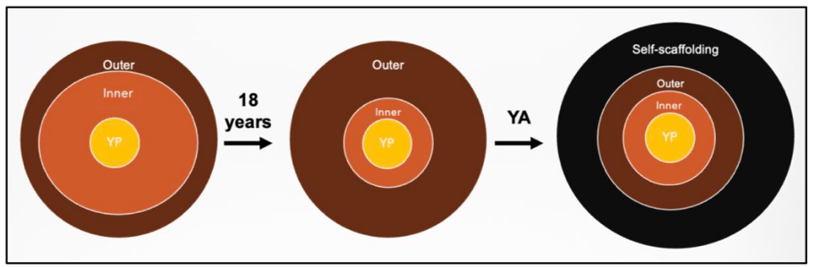
The research emphasises the need for layers of provisions, support, and accountability around young people, conceptualised as ‘scaffolding’, adapting Bruner’s (1978) idea of transient support as they transition into adulthood. The inner core scaffolding includes essential provisions like healthcare and education, as seen with the young people at Oberstown. Beyond this, a young person develops an outer layer of support through their social network, family, and connections, which is shaped by available social capital. Upon reaching the age of majority, young people lose many rights and provisions granted to them as minors. With the weakening or disintegration of the inner core scaffolding, young people become more dependent on their outer layer of support, primarily their social network. When this outer support is insufficient or weakened by criminal justice sanctions or imprisonment, they must resort to ‘self-scaffolding’. This self-scaffolding acts as a protective mechanism, created for their safety and security. These self-scaffolding mechanisms can be beneficial or harmful, and are explored in more detail in the theme of ‘agency’. The research concludes that the criminal justice system can play a crucial role in fostering multi-layered scaffolding for young people, which may reduce recidivism and aid their journey toward desistance. By offering appropriate layers of support, the system can help young people navigate the challenges of adulthood and criminal justice involvement.
Figure 1. Three layers of ‘scaffolding’ around a young person
Agency
This research shows that young people transitioning to adulthood and criminal justice settings need to become more agentic. This process involves developing emotional control and positive identity capital. When inner scaffolding weakens at the age of majority and outer scaffolding, such as social capital, is insufficient or disrupted by incarceration, young people create self-scaffolding to follow a ‘developmental individualisation’ pathway (Healy, 2013, p. 563). This self-support system helps them cope with their circumstances. Three aspects of agency where young people self-scaffold—sometimes beneficial, sometimes harmful—are navigating emotions, building positive identity through self-esteem and self-efficacy, and striving for self-assurance and future aspirations.
The research highlights the importance of young adults beginning the journey toward self-actualisation, using positive self-scaffolding mechanisms to foster agentic qualities. Custodial transitions are seen as opportunities to help young people use these mechanisms, navigate emotional challenges, and build positive identity capital, moving them toward self-actualisation.
Communication
The final thematic finding of the research relates to the prevalence of speech, language and communication needs among young people involved in the criminal justice system. Young adults often exit youth services and experience an abrupt reduction in the level of support received, despite often needing as much communication support as children. Many young people involved in this research did not comprehend or truly participate in the criminal justice system process, highlighting the need for more effective communication at all stages of the criminal justice system. To truly participate in a criminal justice system, a young person must be able to communicate with the process. Speech, language, and communication difficulties affect an individual’s expressive and receptive language skills. Often referred to as a ‘hidden disability’, Developmental Language Disorder (DLD) is frequently undiagnosed. This project considers the impact of a DLD at four stages of the criminal justice process, three of which are identified by Sowerbutts et al. (2021): pre-conviction, peri-conviction, post-conviction, and an additional post-release stage identified in this study. Two issues arise from this process: compliance with legislation and dialogic legitimacy, i.e. the fair, moral, and ethical use of conversation and dialogue between multiple parties to understand or explore the meaning of something. This project suggests four mechanisms that may enhance the process: systematic screening/assessment; training of actors; an official provision for speech and language therapists; and registered intermediaries.
Conclusion
This research highlights the distinct needs of young adults transitioning from youth to adult justice systems in Ireland, focusing on the critical period between 18 and 25. The findings emphasise the dual liminality these individuals experience, caught between childhood and adulthood, and between youth and adult justice provisions. Using a mixed-methods approach, the study shows that young people in this cohort require tailored support to navigate custodial transitions, including stability, multi-layered scaffolding, agency development, and effective communication.
The research underscores the importance of viewing young adults as a distinct group within the criminal justice system, with unique developmental, psychological, and social needs. Addressing these needs is vital for supporting desistance and reducing recidivism. The study advocates for a cohesive, interdisciplinary approach that bridges gaps between youth and adult services, ensuring smoother, more supportive transitions.
Ultimately, this research contributes to the growing literature on young adults in the criminal justice system, providing evidence-based insights to inform policy and practice. By integrating young people’s voices and experiences, this work lays the foundation for developing more effective, age-appropriate interventions, leading to better outcomes for this vulnerable group in the justice system.
This research was funded by the Irish Research Council Employment-Based Programme, in collaboration with University College Dublin and the Probation Service. The researcher had dual status as an employee of the Probation Service, based in Deonach – a community based organisation in a suburb of Dublin, and a postgraduate student at University College Dublin for the duration of the three-year programme from 2021 to 2024.
References
Arnett, J. J. (2000) Emerging Adulthood: A Theory of Development From the Late Teens Through the Twenties. The American Psychologist, 55(5), 469-480.
Bruner, J. S. (1978) The Role of Dialogue in Language Acquisition. In Sinclair, A., Jarvelle, R. J., and Levelt, W. J. M., eds. (1978) The Child’s Conception of Language. New York: Springer-Verlag. 241-257.
Central Statistics Office (2023) Prison Re-offending Statistics 2020. Dublin: Central Statistics Office.
Department of Justice (2021) Youth Justice Strategy 2021-2027. Dublin: Department of Justice.
Farrington, D. P., Loeber, R., and Howell, J. C. (2012) Young Adult Offenders: The Need for More Effective Legislative Options and Justice Processing: Young Adult Offenders. Criminology and Public Policy, 11(4), 729-750.
Healy, D. (2013) Changing Fate? Agency and the Desistance Process. Theoretical Criminology, 17(4), 557-574.
Irish Penal Reform Trust (2015) Turnaround Youth: Young Adults (18-24) in the Criminal Justice System – The Case for a Distinct Approach. Dublin: Irish Penal Reform Trust.
Irish Prison Service (2020) Annual Report 2020. Dublin: Irish Prison Service.
pedagogy. New York: State University of New York Press.
Sowerbutts, A., Eaton-Rosen, E., Bryan, K., and Beeke, S. (2021) Supporting Young Offenders to Communicate in the Youth Justice System: A Scoping Review. Speech, Language and Hearing, 24(2), 87-104.

